
What to Do / What to Know
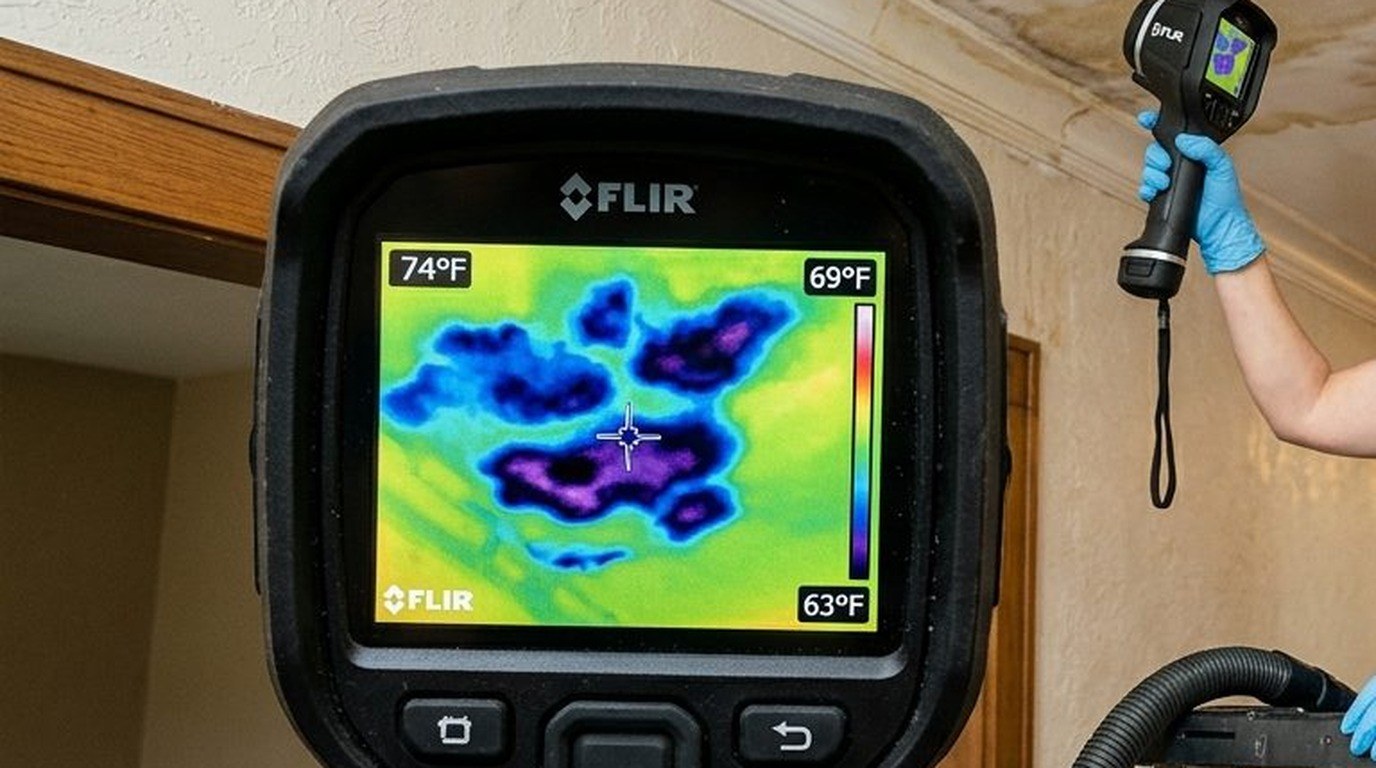
- Do not stand directly under a bulging or sagging ceiling.
- Move people and valuables away from the fall zone.
- Shut off the leak source if safe.
- Consider electrical fixtures in or near the wet ceiling as a hazard until evaluated.
- Check the room above/attic source and the ceiling materials below.
- Do not assume one visible stain defines the entire wet area.
Why This Matters
Water extraction is most effective when it is matched to the source, materials and actual spread of the loss. Removing visible water is important, but the next decisions depend on what remains wet, whether the water is sanitary, how long materials have been affected and whether the source has been corrected. That is why the practical sequence is source control → extraction → moisture mapping → drying → verification.
Where Hidden Moisture Can Remain
- Under carpet cushion and at the subfloor
- Beneath floating vinyl plank or laminate
- Behind baseboards and lower drywall
- Inside cabinet toe-kicks and vanity cavities
- At flooring transitions and door thresholds
- In ceiling drywall, insulation and wall intersections
- In adjoining rooms where water followed seams or low spots
Spring Hill / Florida Context
Spring Hill properties are in a warm, humid Florida climate. UF/IFAS explains that air conditioners contribute to indoor moisture removal as they cool. After a water loss, that means drying is not just about blowing air across a wet surface: indoor humidity, dehumidification, material access and HVAC condition all affect how quickly moisture can leave the structure.
When Professional Help Becomes More Valuable
- Water has spread into more than one room or beneath fixed materials.
- The source is sewage, outdoor floodwater or otherwise potentially contaminated.
- The ceiling is sagging, electrical conditions are uncertain or the area is unsafe to enter.
- You cannot tell where the water stopped or whether walls/floors are still wet.
- Drying is not progressing or odor/visible deterioration develops.
- Commercial operations, tenants, inventory or critical spaces are affected.
Common Mistakes to Avoid
- Judging dryness only from the visible surface
- Ignoring cushion, underlayment, subfloor or wall cavities
- Reinstalling baseboards or flooring before underlying materials are verified dry
- Assuming every wet material must be discarded or, conversely, that everything can be saved
- Using heat aggressively without considering the material and assembly
The Assembly Matters More Than the Surface
A floor, wall or ceiling is usually a layered assembly. The finished surface may dry first while a concealed layer remains wet. The useful question is therefore not “Does it feel dry?” but “Which layers got wet, can they be accessed, and are measurements showing that they are returning to an appropriate condition?”
A Practical Decision Test
| Question | Why it changes the next step |
|---|---|
| Is the source stopped? | Drying cannot succeed if water is still entering the structure. |
| Is the water sanitary? | Contamination affects protective measures, airflow and what porous materials can be kept. |
| Did water reach hidden layers? | Surface drying may not address cushion, subfloor, wall cavities or insulation. |
| Are materials responding to drying? | Stable or rising moisture readings may indicate blocked access, continuing water or material damage. |
| Is the area safe? | Electrical, ceiling, structural and contamination hazards override ordinary cleanup steps. |
Frequently Asked Questions
Can I tell whether a material is dry by touching it?
Not reliably. The surface can feel dry while deeper layers remain wet. Moisture measurements and comparison with unaffected material provide better information.
Why is the 24–48 hour window mentioned so often?
EPA guidance recommends drying wet or damp areas and materials within 24 to 48 hours when possible to reduce the chance of mold growth. It is a response goal, not a guarantee that mold will or will not grow.
Does water extraction fix the source of the leak?
Not necessarily. Plumbing, roofing, HVAC or appliance repair may be a separate trade. Extraction and drying address water already in the building.
Sources & Further Reading
- US EPA — A Brief Guide to Mold, Moisture and Your Home: https://www.epa.gov/mold/brief-guide-mold-moisture-and-your-home
- US EPA — Water Damage Cleanup and Mold Prevention Table: https://www.epa.gov/sites/default/files/2014-08/documents/table1.pdf
- UF/IFAS — Energy Efficient Homes: Air Conditioning: https://ask.ifas.ufl.edu/publication/FY1026
- Hernando County — Flooding and watershed resources: https://www.hernandocounty.us/public-safety/emergency-management/flooding/