
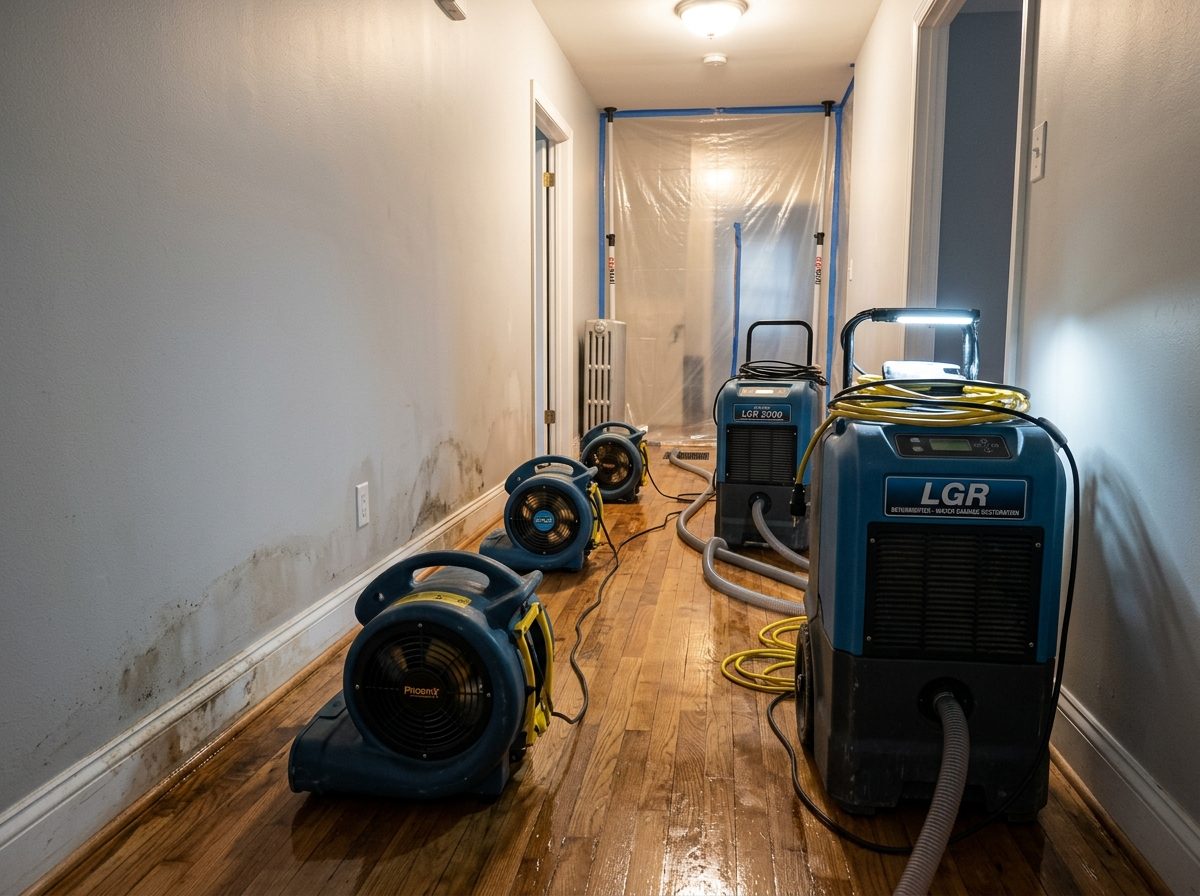
Commercial water damage requires rapid moisture mitigation engineered to protect ongoing business operations, tenant occupancy, inventory, and mechanical rooms. Staged zoning, detailed documentation for risk managers, and commercial drying minimize total property downtime.
When This Service Is the Right Starting Point
- Office or retail plumbing leak
- Roof leak over customer or work areas
- Sprinkler or supply-line release
- Warehouse or storage-area water intrusion
- Multi-tenant property where affected and unaffected spaces must be separated
What the Service Actually Solves
The commercial goal is not merely “dry fast.” It is to identify the affected footprint, remove water safely, preserve viable operations when possible and document decisions so property managers, tenants and vendors understand what is open, what is restricted and what is still drying.
A practical water-damage service should make the sequence visible to the property owner: control further water entry, understand the water source, remove accessible water, determine what materials are wet, establish appropriate drying conditions and verify progress. The exact mix of extraction, selective removal, cleaning and drying changes with the source and materials.
How the Work Proceeds
- Confirm the source condition and basic site safety. If active plumbing, roof, HVAC or wastewater repairs are outside the service scope, identify the trade that must correct the source.
- Inspect the visible loss and trace likely migration paths into adjacent rooms, under flooring, around cabinets and into wall or ceiling assemblies.
- Remove accessible water when conditions allow. Use the method appropriate for depth, floor type, access and contamination.
- Measure affected materials and create drying conditions for items that are appropriate to retain.
- Recheck the affected area, document progress and identify materials that are not responding or that require a different approach.
Material and Condition Guide
| Condition / material | Why it matters |
|---|---|
| Customer-facing areas | Prioritize slip hazards, access control and separation between wet work and open business areas. |
| Inventory/storage | Move dry contents out of the migration path and document wet or contaminated inventory before disposal. |
| Tenant spaces | Define which suites are affected and communicate equipment placement/access requirements clearly. |
| Large floor plates | Use moisture mapping and zoning so extraction and drying progress can be tracked by area. |
| Critical equipment | Do not energize or move electrical/electronic equipment without appropriate specialist input when water contact is possible. |
Spring Hill / Hernando County Relevance
Spring Hill commercial properties range from small professional suites and retail spaces to larger service, storage, and institutional buildings. Commercial water mitigation emphasizes scalable containment: zoning affected areas, protecting unaffected inventory and electronics, coordinating shift access, and continuously monitoring drying progress.
What Property Owners Can Do Before Service
- Stop the source only if it can be done safely and without entering standing water around electrical hazards.
- Keep people away from sagging ceilings, contaminated water and slippery areas.
- Photograph affected rooms and the apparent source when safe, especially before moving damaged contents.
- Move dry, portable belongings away from the water path without spreading contaminated water into clean areas.
- Avoid assuming a dry surface means the structure is dry; wait for material checks before replacing trim, flooring or finishes.
What a Thorough Initial Assessment Should Record
Before extraction starts, the team should establish a baseline that explains what happened and what is affected. This prevents the work from becoming “set equipment and hope.” A concise initial record is useful for the property owner, technicians returning for monitoring, property managers and any later repair contractor.
- Apparent source and whether it is stopped or still active
- Estimated time discovered and, if known, how long materials were wet
- Rooms and materials visibly affected
- Likely migration paths into adjacent rooms, wall cavities, flooring or ceilings
- Water condition: clean plumbing, used water, sewage, outdoor floodwater or unknown
- Safety issues such as sagging ceilings, wet electrical equipment, slippery areas or structural damage
- Initial moisture readings or affected-area map
- Photos before major movement, extraction or material removal
Spring Hill Water-Loss Scenarios
| Scenario | Practical response |
|---|---|
| Retail leak before opening | Zone the affected area, address slip hazards and determine whether unaffected customer areas can operate safely. |
| Office suite water release | Check shared walls, neighboring suites and floor penetrations in addition to the source room. |
| Warehouse/storage loss | Protect dry inventory from migration paths and document wet stock before relocation or disposal. |
Documentation That Adds Real Value
Good documentation is not paperwork for its own sake. It should explain what was wet, what was done and what changed. That is especially useful when a job extends over several days or when a plumber, roofer, HVAC contractor, property manager or insurer becomes involved.
- Photos of the source and affected areas before and after extraction
- A simple room-by-room moisture map or reading log
- Equipment placement and major changes to the drying setup
- Materials removed and the reason for removal
- Notes about inaccessible areas or conditions requiring another trade
- Final or transition readings showing why drying equipment was removed or why additional work was recommended
When the Scope Should Change
A water-loss plan should change when new information appears. Examples include finding sewage contamination, discovering water beneath a floor that was initially thought to be dry, learning that the leak had been occurring for days instead of hours, or finding damaged electrical components. Professional water mitigation is an assessment-driven process, not a fixed package. Initial mitigation plans adapt as hidden moisture boundaries are confirmed through deep structural readings.
Frequently Asked Questions
Can a business stay open during water restoration?
Sometimes unaffected areas can remain operational, but the answer depends on safety, contamination, noise, access, power and local operational requirements.
Can you work after hours?
Only state after-hours availability if the company actually offers it. Commercial pages should list confirmed scheduling options rather than generic “24/7” claims.
What documentation is useful for property managers?
Useful records can include photos, affected-area maps, equipment placement, moisture readings, work authorizations and a clear list of materials removed or retained.
Do you handle large commercial losses?
Commercial water damage response scales to the specific building footprint, deploying targeted containment and commercial extraction units suited to the facility layout.
Sources & Further Reading
- US EPA — A Brief Guide to Mold, Moisture and Your Home: https://www.epa.gov/mold/brief-guide-mold-moisture-and-your-home
- US EPA — Water Damage Cleanup and Mold Prevention Table: https://www.epa.gov/sites/default/files/2014-08/documents/table1.pdf
- UF/IFAS — Energy Efficient Homes: Air Conditioning: https://ask.ifas.ufl.edu/publication/FY1026
- Hernando County — Flooding / Floodplain Management: https://www.hernandocounty.us/public-safety/emergency-management/flooding/