
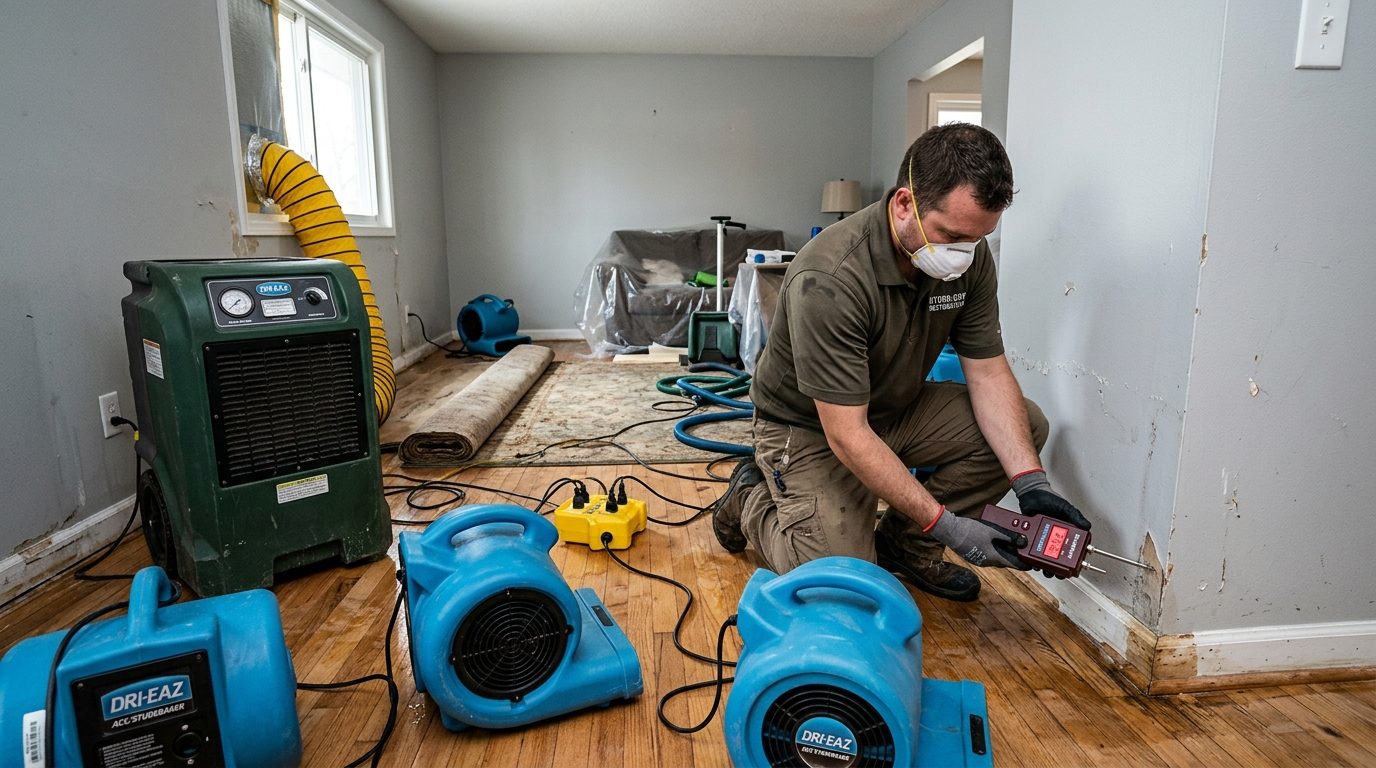
Moisture detection answers the question that eyesight cannot: where did the water actually travel? Calibrated pin meters, non-invasive sensors, and thermal imaging map concealed boundaries inside building assemblies, preventing hidden moisture pockets from being left behind.
When This Service Is the Right Starting Point
- The visible puddle was cleaned up but materials still feel damp
- Water reached a wall, cabinet or flooring transition
- A ceiling leak may have affected insulation or wall cavities
- Floating flooring may have water beneath it
- Drying equipment is running and progress needs to be checked
What the Service Actually Solves
A water-loss map should be practical, not just a collection of meter numbers. The technician is looking for patterns: what is wet compared with a known dry area, how far the affected zone extends, which materials are involved and whether readings are moving in the right direction during drying.
A practical water-damage service should make the sequence visible to the property owner: control further water entry, understand the water source, remove accessible water, determine what materials are wet, establish appropriate drying conditions and verify progress. The exact mix of extraction, selective removal, cleaning and drying changes with the source and materials.
How the Work Proceeds
- Confirm the source condition and basic site safety. If active plumbing, roof, HVAC or wastewater repairs are outside the service scope, identify the trade that must correct the source.
- Inspect the visible loss and trace likely migration paths into adjacent rooms, under flooring, around cabinets and into wall or ceiling assemblies.
- Remove accessible water when conditions allow. Use the method appropriate for depth, floor type, access and contamination.
- Measure affected materials and create drying conditions for items that are appropriate to retain.
- Recheck the affected area, document progress and identify materials that are not responding or that require a different approach.
Material and Condition Guide
| Condition / material | Why it matters |
|---|---|
| Pin-type moisture meter | Useful for localized readings in appropriate materials and for comparing affected to unaffected areas. |
| Non-invasive moisture meter | Useful for rapid scanning and locating areas that may need closer inspection; readings can be influenced by material density and assemblies. |
| Thermal imaging | Can highlight temperature differences that suggest moisture patterns, but it does not directly measure moisture and should be confirmed with appropriate meters. |
| Thermo-hygrometer | Measures air temperature and relative humidity; useful for evaluating drying conditions and dehumidification performance. |
| Visual/physical inspection | Checks swelling, staining, delamination, softness, odor and other clues that instruments alone cannot explain. |
Spring Hill / Hernando County Relevance
Humidity matters when interpreting a Florida water loss. High ambient moisture can slow evaporation, and air-conditioned spaces can behave differently from an open garage or a storm-damaged building. Measurements should be considered together with material type, indoor conditions and the history of the leak.
What Property Owners Can Do Before Service
- Stop the source only if it can be done safely and without entering standing water around electrical hazards.
- Keep people away from sagging ceilings, contaminated water and slippery areas.
- Photograph affected rooms and the apparent source when safe, especially before moving damaged contents.
- Move dry, portable belongings away from the water path without spreading contaminated water into clean areas.
- Avoid assuming a dry surface means the structure is dry; wait for material checks before replacing trim, flooring or finishes.
What a Thorough Initial Assessment Should Record
Before extraction starts, the team should establish a baseline that explains what happened and what is affected. This prevents the work from becoming “set equipment and hope.” A concise initial record is useful for the property owner, technicians returning for monitoring, property managers and any later repair contractor.
- Apparent source and whether it is stopped or still active
- Estimated time discovered and, if known, how long materials were wet
- Rooms and materials visibly affected
- Likely migration paths into adjacent rooms, wall cavities, flooring or ceilings
- Water condition: clean plumbing, used water, sewage, outdoor floodwater or unknown
- Safety issues such as sagging ceilings, wet electrical equipment, slippery areas or structural damage
- Initial moisture readings or affected-area map
- Photos before major movement, extraction or material removal
Spring Hill Water-Loss Scenarios
| Scenario | Practical response |
|---|---|
| Dry-looking wall base | A non-invasive scan may identify a wider affected area, followed by more specific readings where needed. |
| Ceiling stain with no active drip | Measurements can help distinguish a historical stain from material that is still wet. |
| Flooring transition | Scanning both rooms can reveal migration beyond the obvious boundary. |
Documentation That Adds Real Value
Good documentation is not paperwork for its own sake. It should explain what was wet, what was done and what changed. That is especially useful when a job extends over several days or when a plumber, roofer, HVAC contractor, property manager or insurer becomes involved.
- Photos of the source and affected areas before and after extraction
- A simple room-by-room moisture map or reading log
- Equipment placement and major changes to the drying setup
- Materials removed and the reason for removal
- Notes about inaccessible areas or conditions requiring another trade
- Final or transition readings showing why drying equipment was removed or why additional work was recommended
When the Scope Should Change
A water-loss plan should change when new information appears. Examples include finding sewage contamination, discovering water beneath a floor that was initially thought to be dry, learning that the leak had been occurring for days instead of hours, or finding damaged electrical components. Professional water mitigation is an assessment-driven process, not a fixed package. Initial mitigation plans adapt as hidden moisture boundaries are confirmed through deep structural readings.
Frequently Asked Questions
Can a moisture meter find a leak inside a wall?
A moisture meter can help identify damp building materials, but it does not necessarily identify the exact plumbing defect. Source diagnosis may require plumbing, roofing or HVAC inspection.
Does thermal imaging prove that an area is wet?
No. Thermal cameras show temperature patterns. Those patterns can suggest possible moisture, but they should be verified with moisture measurements and inspection.
Why take readings more than once?
Repeated readings show whether a material is drying, staying unchanged or becoming wetter. Trend data is more useful than a single isolated number.
What is a dry standard?
It is a reasonable reference condition based on comparable unaffected materials and the specific building/material context. There is no single universal moisture number for every material.
Sources & Further Reading
- US EPA — A Brief Guide to Mold, Moisture and Your Home: https://www.epa.gov/mold/brief-guide-mold-moisture-and-your-home
- US EPA — Water Damage Cleanup and Mold Prevention Table: https://www.epa.gov/sites/default/files/2014-08/documents/table1.pdf
- UF/IFAS — Energy Efficient Homes: Air Conditioning: https://ask.ifas.ufl.edu/publication/FY1026
- Hernando County — Flooding / Floodplain Management: https://www.hernandocounty.us/public-safety/emergency-management/flooding/