
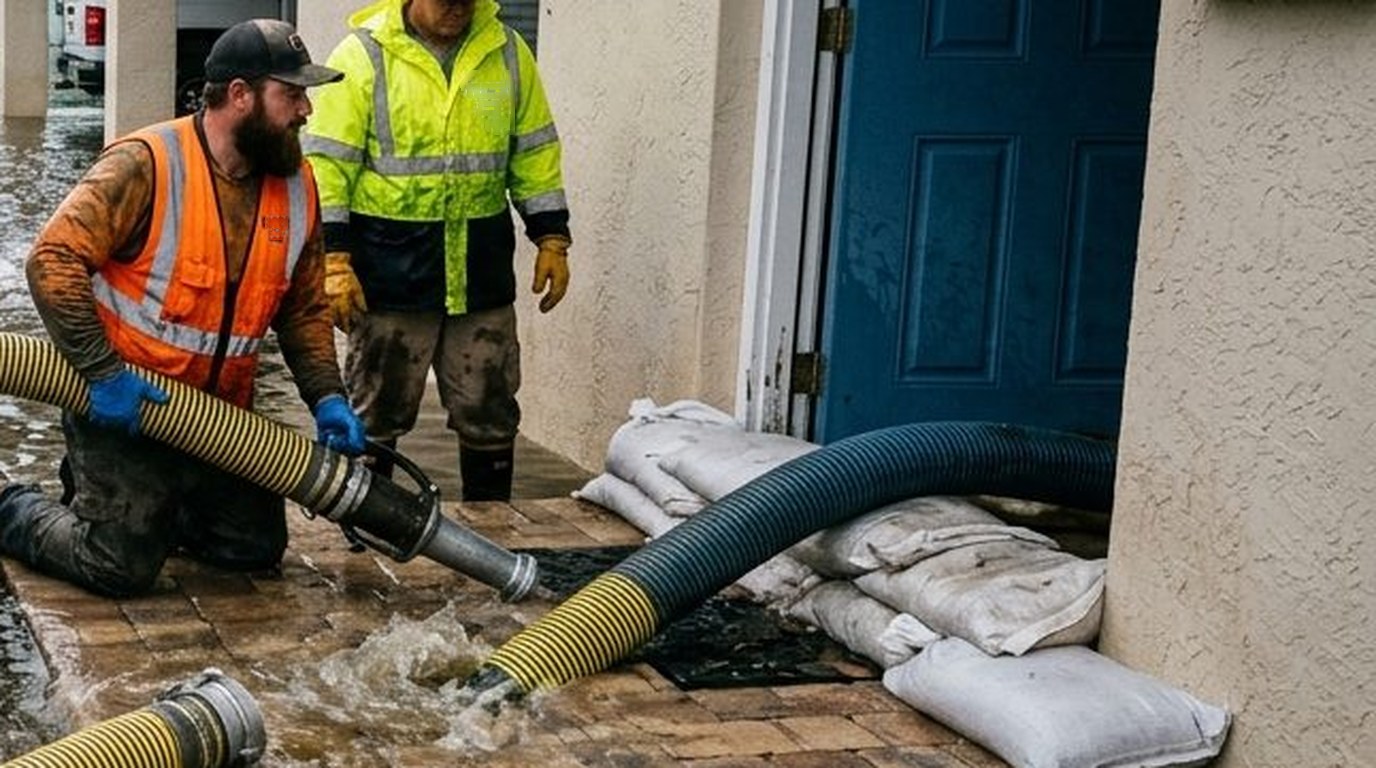
Water-Damage Mitigation & Extraction in Weeki Wachee, FL
Weeki Wachee and surrounding western Hernando County communities feature unique environmental characteristics, including riverine corridors, varied groundwater levels, and high seasonal humidity. Indoor water losses from plumbing breaks, AC condensate drain clogs, and storm intrusion require prompt physical extraction and controlled dehumidification to prevent prolonged moisture saturation in building materials.
Common Water-Damage Sources in Weeki Wachee
- AC Condensate & Air Handler Leaks: High cooling demands lead to heavy condensation. Blocked condensate drain lines or cracked pans frequently spill moisture into closets and ceilings.
- Plumbing Supply Line Leaks: Pressurized pipe breaks behind walls or under sinks that spread rapidly across concrete slabs and subflooring.
- Washing Machine & Appliance Failures: Supply hose bursts that discharge dozens of gallons across laundry rooms and adjoining living spaces.
- Groundwater & Heavy Rain Saturation: Prolonged tropical storms that saturate exterior soils and create localized drainage challenges around foundations.
- Toilet Overflows & Drain Backups: Supply line failures or wastewater backups that require careful contamination categorization before drying.
- Roof & Window Water Intrusion: Wind-driven storm rains that penetrate building envelopes and saturate insulation and ceiling drywall.
The Water-Extraction Sequence
- Source Control & Hazard Check: Verify the active leak is isolated and ensure wet rooms are electrically safe before starting work.
- Moisture Mapping: Trace hidden water migration through drywall, behind cabinets, and under floating floors using calibrated electronic meters.
- Bulk Water Extraction: Extract standing liquid water using commercial extractors to reduce the volume of moisture trapped in the structure.
- Controlled Structural Drying: Position commercial LGR dehumidifiers and high-velocity air movers to establish continuous evaporation.
- Psychrometric Monitoring: Record temperature, relative humidity, and material moisture content daily until dry baselines are met.
What Our Weeki Wachee Water-Damage Assessment Evaluates
- Is the active water leak completely stopped?
- Did water seep beneath vinyl plank, tile, or laminate flooring into the subfloor?
- Has moisture wicked up drywall or interior partition wall cavities?
- What sanitary precautions are needed based on the water source?
- How many dehumidifiers and air movers are required to achieve target drying standards?
Flooring and Framing Considerations in Humid Environments
Weeki Wachee’s humid subtropical climate means outdoor air cannot be relied upon to dry building interiors. Opening windows often introduces additional humidity into a water-damaged property. Professional structural drying uses closed-environment dehumidification to pull moisture out of the air while air movers draw water out of porous materials.
Frequently Asked Questions
Do you serve all areas around Weeki Wachee?
Yes. Our response coverage extends throughout Weeki Wachee and listed Hernando County communities. Submit your property ZIP code or request service online to confirm dispatch availability.
Should I open windows after water damage in Weeki Wachee?
Generally no. In Florida’s humid climate, outside air frequently has higher moisture content than indoor air, which can slow down drying and encourage microbial growth. Closed-system commercial dehumidification is strongly recommended.
Where can I verify my property’s flood risk in Weeki Wachee?
Consult the Hernando County Emergency Management Forerunner flood tool or FEMA’s Flood Map Service Center for exact parcel-level flood zone designations.
Sources & Further Reading
- Hernando County Emergency Management — Flood Zone Lookup: Hernando County Floodplain Tools
- UF/IFAS Extension — Managing Moisture & Air Quality in Florida Homes: UF/IFAS Publications
- U.S. EPA — A Brief Guide to Mold, Moisture, and Your Home