
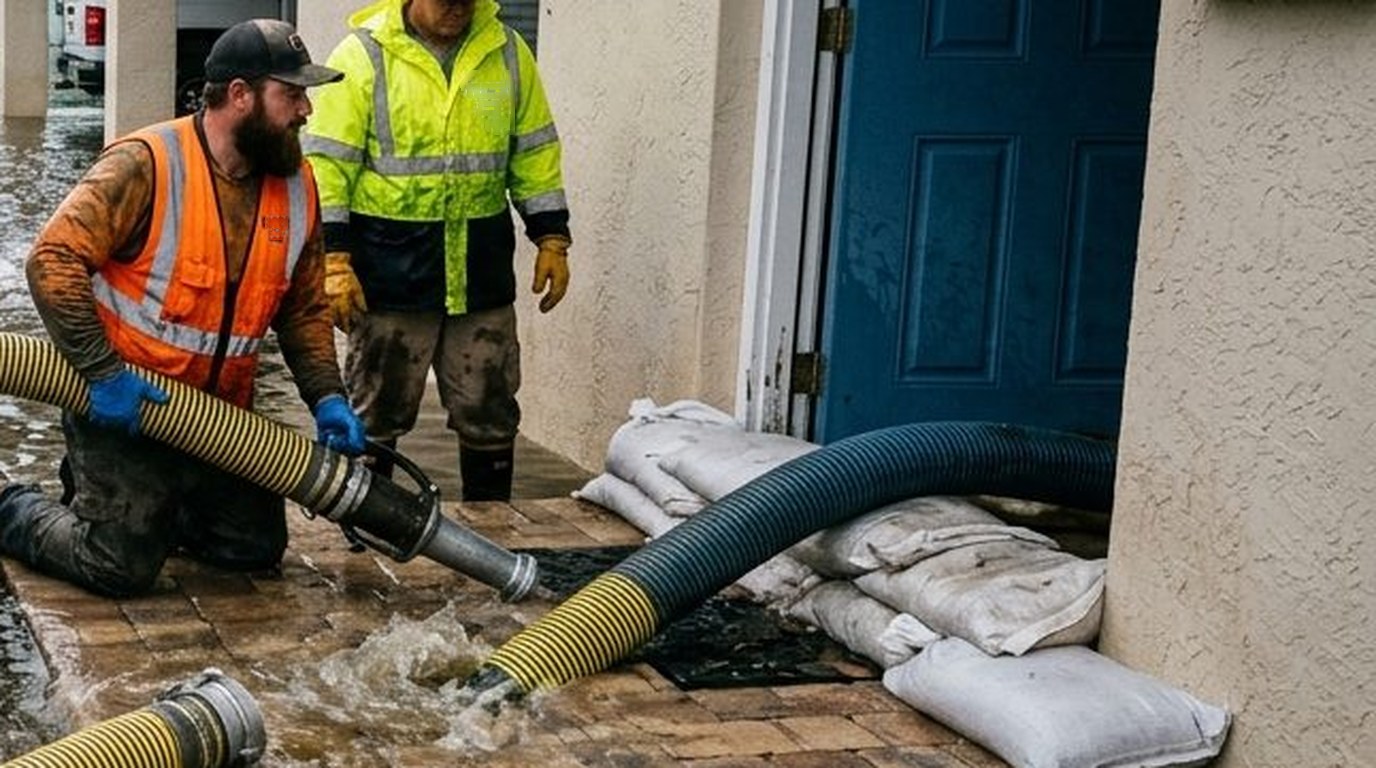
Storm water intrusions often involve multiple simultaneous entry points—including roof penetrations, window seals, and rising exterior ground runoff. Mitigation teams stabilize structural envelopes, extract bulk intrusion water, and establish targeted containment zones before structural drying proceeds.
When This Service Is the Right Starting Point
- Roof covering or flashing damage allows rain inside
- Wind-driven rain enters around doors or windows
- Stormwater reaches a garage or living space from outside
- Multiple ceiling or wall areas become wet after a severe storm
- Power loss or HVAC shutdown leaves a wet building humid for an extended period
What the Service Actually Solves
Storm losses frequently combine clean rainwater with outdoor runoff. They may also involve roof damage, compromised glazing, electrical hazards, and prolonged elevated humidity. An effective storm response coordinates emergency source protection, bulk water extraction, moisture mapping, and structural drying as connected phases.
A practical water-damage service should make the sequence visible to the property owner: control further water entry, understand the water source, remove accessible water, determine what materials are wet, establish appropriate drying conditions and verify progress. The exact mix of extraction, selective removal, cleaning and drying changes with the source and materials.
How the Work Proceeds
- Confirm the source condition and basic site safety. If active plumbing, roof, HVAC or wastewater repairs are outside the service scope, identify the trade that must correct the source.
- Inspect the visible loss and trace likely migration paths into adjacent rooms, under flooring, around cabinets and into wall or ceiling assemblies.
- Remove accessible water when conditions allow. Use the method appropriate for depth, floor type, access and contamination.
- Measure affected materials and create drying conditions for items that are appropriate to retain.
- Recheck the affected area, document progress and identify materials that are not responding or that require a different approach.
Material and Condition Guide
| Condition / material | Why it matters |
|---|---|
| Roof rain intrusion | Stop/cover the source when safe; inspect ceilings, insulation, walls and flooring below. |
| Wind-driven rain | Check window/door perimeters, wall cavities, sill areas and floor edges. |
| Outdoor floodwater | Treat as potentially contaminated and follow flood-cleanup precautions. |
| Power outage after water loss | Dehumidification and HVAC may be interrupted; drying plans must account for available power and safe electrical service. |
| Multiple leak points | Create a moisture map so each area is tracked rather than assuming one visible stain represents the whole loss. |
Spring Hill / Hernando County Relevance
Hernando County residents are exposed to tropical weather and heavy-rain events, and coastal communities have additional flood considerations. The county’s floodplain resources and official emergency information are useful outbound references. For the service copy, stay focused on interior water: where it entered, which materials became wet and what can safely be extracted or dried.
What Property Owners Can Do Before Service
- Stop the source only if it can be done safely and without entering standing water around electrical hazards.
- Keep people away from sagging ceilings, contaminated water and slippery areas.
- Photograph affected rooms and the apparent source when safe, especially before moving damaged contents.
- Move dry, portable belongings away from the water path without spreading contaminated water into clean areas.
- Avoid assuming a dry surface means the structure is dry; wait for material checks before replacing trim, flooring or finishes.
What a Thorough Initial Assessment Should Record
Before extraction starts, the team should establish a baseline that explains what happened and what is affected. This prevents the work from becoming “set equipment and hope.” A concise initial record is useful for the property owner, technicians returning for monitoring, property managers and any later repair contractor.
- Apparent source and whether it is stopped or still active
- Estimated time discovered and, if known, how long materials were wet
- Rooms and materials visibly affected
- Likely migration paths into adjacent rooms, wall cavities, flooring or ceilings
- Water condition: clean plumbing, used water, sewage, outdoor floodwater or unknown
- Safety issues such as sagging ceilings, wet electrical equipment, slippery areas or structural damage
- Initial moisture readings or affected-area map
- Photos before major movement, extraction or material removal
Spring Hill Water-Loss Scenarios
| Scenario | Practical response |
|---|---|
| Wind-driven rain at a window | Check sill, wall below, baseboard and flooring rather than focusing only on the visible drip. |
| Roof leak during a tropical storm | Temporary source control and safe access come before interior drying can be effective. |
| Storm flooding plus power loss | The drying plan must account for safe electrical service and the fact that normal HVAC dehumidification may be unavailable. |
Documentation That Adds Real Value
Good documentation is not paperwork for its own sake. It should explain what was wet, what was done and what changed. That is especially useful when a job extends over several days or when a plumber, roofer, HVAC contractor, property manager or insurer becomes involved.
- Photos of the source and affected areas before and after extraction
- A simple room-by-room moisture map or reading log
- Equipment placement and major changes to the drying setup
- Materials removed and the reason for removal
- Notes about inaccessible areas or conditions requiring another trade
- Final or transition readings showing why drying equipment was removed or why additional work was recommended
When the Scope Should Change
A water-loss plan should change when new information appears. Examples include finding sewage contamination, discovering water beneath a floor that was initially thought to be dry, learning that the leak had been occurring for days instead of hours, or finding damaged electrical components. Professional water mitigation is an assessment-driven process, not a fixed package. Initial mitigation plans adapt as hidden moisture boundaries are confirmed through deep structural readings.
Frequently Asked Questions
Can interior drying start before the roof is fixed?
Temporary source control may allow interior mitigation to begin, but ongoing water entry will undermine drying. Roof safety and weather conditions come first.
Is rainwater considered clean?
Rainwater that enters directly may begin relatively clean, but once it contacts roofing materials, soil, exterior surfaces or contaminated building components, conditions can change. The actual path matters.
What if the power is out?
Do not improvise unsafe electrical setups. Extraction and drying equipment require adequate power. The restoration plan should coordinate with safe electrical service and any generator use permitted by the equipment and site conditions.
Should I photograph storm damage before cleanup?
When it is safe, photos of the source, affected areas and damaged contents can be useful documentation before materials are moved or discarded.
Sources & Further Reading
- US EPA — A Brief Guide to Mold, Moisture and Your Home: https://www.epa.gov/mold/brief-guide-mold-moisture-and-your-home
- US EPA — Water Damage Cleanup and Mold Prevention Table: https://www.epa.gov/sites/default/files/2014-08/documents/table1.pdf
- UF/IFAS — Energy Efficient Homes: Air Conditioning: https://ask.ifas.ufl.edu/publication/FY1026
- Hernando County — Flooding / Floodplain Management: https://www.hernandocounty.us/public-safety/emergency-management/flooding/