
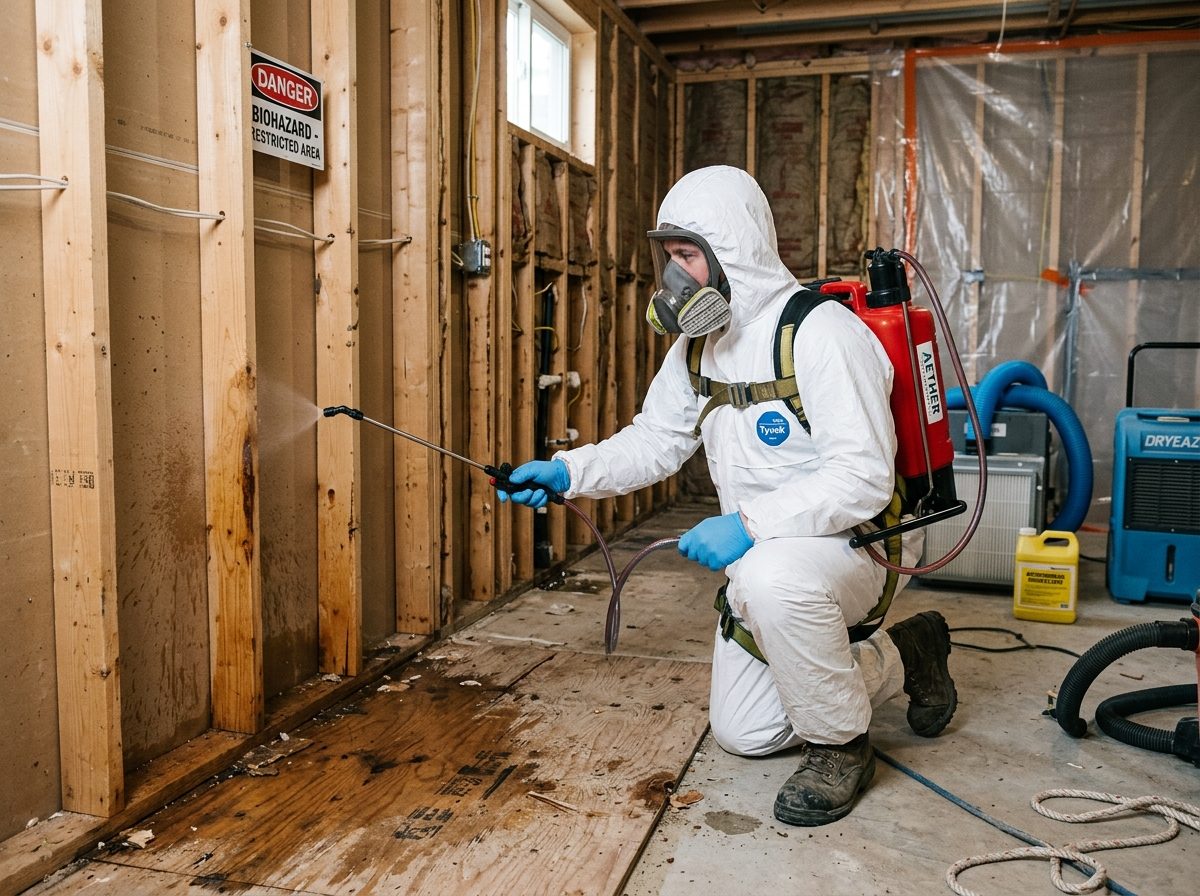
Water damage restoration coordinates the complete recovery lifecycle beyond emergency water removal. It establishes baseline moisture standards, manages industrial drying equipment, verifies structural dryness, and specifies clear scopes for reconstruction.
When This Service Is the Right Starting Point
- Multiple rooms affected by a plumbing failure
- Water moving under flooring or behind baseboards
- Wet ceilings or walls from plumbing, HVAC or roof intrusion
- A loss that needs extraction plus drying and follow-up moisture checks
- Residential or commercial water damage where the full affected area is not yet clear
What the Service Actually Solves
Understanding the complete mitigation sequence helps property owners make informed decisions when unexpected water damage strikes. The core objective of professional mitigation is identifying all moisture boundaries, extracting standing water, and controlling humidity to prevent secondary rot, mold growth, or structural damage.
A practical water-damage service should make the sequence visible to the property owner: control further water entry, understand the water source, remove accessible water, determine what materials are wet, establish appropriate drying conditions and verify progress. The exact mix of extraction, selective removal, cleaning and drying changes with the source and materials.
How the Work Proceeds
- Confirm the source condition and basic site safety. If active plumbing, roof, HVAC or wastewater repairs are outside the service scope, identify the trade that must correct the source.
- Inspect the visible loss and trace likely migration paths into adjacent rooms, under flooring, around cabinets and into wall or ceiling assemblies.
- Remove accessible water when conditions allow. Use the method appropriate for depth, floor type, access and contamination.
- Measure affected materials and create drying conditions for items that are appropriate to retain.
- Recheck the affected area, document progress and identify materials that are not responding or that require a different approach.
Material and Condition Guide
| Condition / material | Why it matters |
|---|---|
| Visible standing water | Extract first when safe and appropriate; then check adjacent and underlying materials. |
| Wet drywall/baseboard | Map the wet area. Decide whether drying in place is reasonable or whether damaged/contaminated material needs removal. |
| Flooring transition | Check both sides of the transition because water often migrates beyond the room where it started. |
| Cabinet or vanity area | Inspect toe-kicks, wall contact points and flooring underneath where accessible. |
| Ceiling leak | Control the source and evaluate sagging, saturation and possible hidden wet insulation before setting airflow. |
Spring Hill / Hernando County Relevance
In Spring Hill, restoration planning frequently needs to account for Florida humidity, air-conditioned interiors, slab and flooring assemblies, storm-related rain entry and HVAC condensate problems. The practical goal is not to “dry the air” in general; it is to reduce moisture in the affected materials to an appropriate condition while controlling indoor humidity.
What Property Owners Can Do Before Service
- Stop the source only if it can be done safely and without entering standing water around electrical hazards.
- Keep people away from sagging ceilings, contaminated water and slippery areas.
- Photograph affected rooms and the apparent source when safe, especially before moving damaged contents.
- Move dry, portable belongings away from the water path without spreading contaminated water into clean areas.
- Avoid assuming a dry surface means the structure is dry; wait for material checks before replacing trim, flooring or finishes.
What a Thorough Initial Assessment Should Record
Before extraction starts, the team should establish a baseline that explains what happened and what is affected. This prevents the work from becoming “set equipment and hope.” A concise initial record is useful for the property owner, technicians returning for monitoring, property managers and any later repair contractor.
- Apparent source and whether it is stopped or still active
- Estimated time discovered and, if known, how long materials were wet
- Rooms and materials visibly affected
- Likely migration paths into adjacent rooms, wall cavities, flooring or ceilings
- Water condition: clean plumbing, used water, sewage, outdoor floodwater or unknown
- Safety issues such as sagging ceilings, wet electrical equipment, slippery areas or structural damage
- Initial moisture readings or affected-area map
- Photos before major movement, extraction or material removal
Spring Hill Water-Loss Scenarios
| Scenario | Practical response |
|---|---|
| A kitchen supply-line break | Water can move from the sink base into toe-kicks, behind cabinets and under adjacent flooring. A restoration plan should separate plumbing repair from extraction and material drying. |
| A ceiling leak from an upstairs fixture | The wet footprint may include ceiling drywall, wall intersections and flooring below. Safety around sagging gypsum comes before cosmetic repair. |
| A multi-room loss | Create a room-by-room moisture map so unaffected areas are not treated as damaged and wet areas are not missed. |
Documentation That Adds Real Value
Good documentation is not paperwork for its own sake. It should explain what was wet, what was done and what changed. That is especially useful when a job extends over several days or when a plumber, roofer, HVAC contractor, property manager or insurer becomes involved.
- Photos of the source and affected areas before and after extraction
- A simple room-by-room moisture map or reading log
- Equipment placement and major changes to the drying setup
- Materials removed and the reason for removal
- Notes about inaccessible areas or conditions requiring another trade
- Final or transition readings showing why drying equipment was removed or why additional work was recommended
When the Scope Should Change
A water-loss plan should change when new information appears. Examples include finding sewage contamination, discovering water beneath a floor that was initially thought to be dry, learning that the leak had been occurring for days instead of hours, or finding damaged electrical components. Professional water mitigation is an assessment-driven process, not a fixed package. Initial mitigation plans adapt as hidden moisture boundaries are confirmed through deep structural readings.
Frequently Asked Questions
Is water damage restoration the same as water extraction?
No. Extraction is one step. Restoration can include assessment, extraction, moisture mapping, drying, selective removal, cleaning and documentation.
Can everything be dried in place?
No. Whether a material can remain depends on the water source, contamination, material condition, construction and how quickly drying can be achieved.
How long does restoration take?
There is no responsible one-size-fits-all duration. Extraction can be relatively quick, while drying and repairs may take longer. Moisture readings and material condition should drive the timeline.
Do you rebuild after drying?
Only publish reconstruction as a service if the business actually provides it or has a defined partner process.
Sources & Further Reading
- US EPA — A Brief Guide to Mold, Moisture and Your Home: https://www.epa.gov/mold/brief-guide-mold-moisture-and-your-home
- US EPA — Water Damage Cleanup and Mold Prevention Table: https://www.epa.gov/sites/default/files/2014-08/documents/table1.pdf
- UF/IFAS — Energy Efficient Homes: Air Conditioning: https://ask.ifas.ufl.edu/publication/FY1026
- Hernando County — Flooding / Floodplain Management: https://www.hernandocounty.us/public-safety/emergency-management/flooding/