
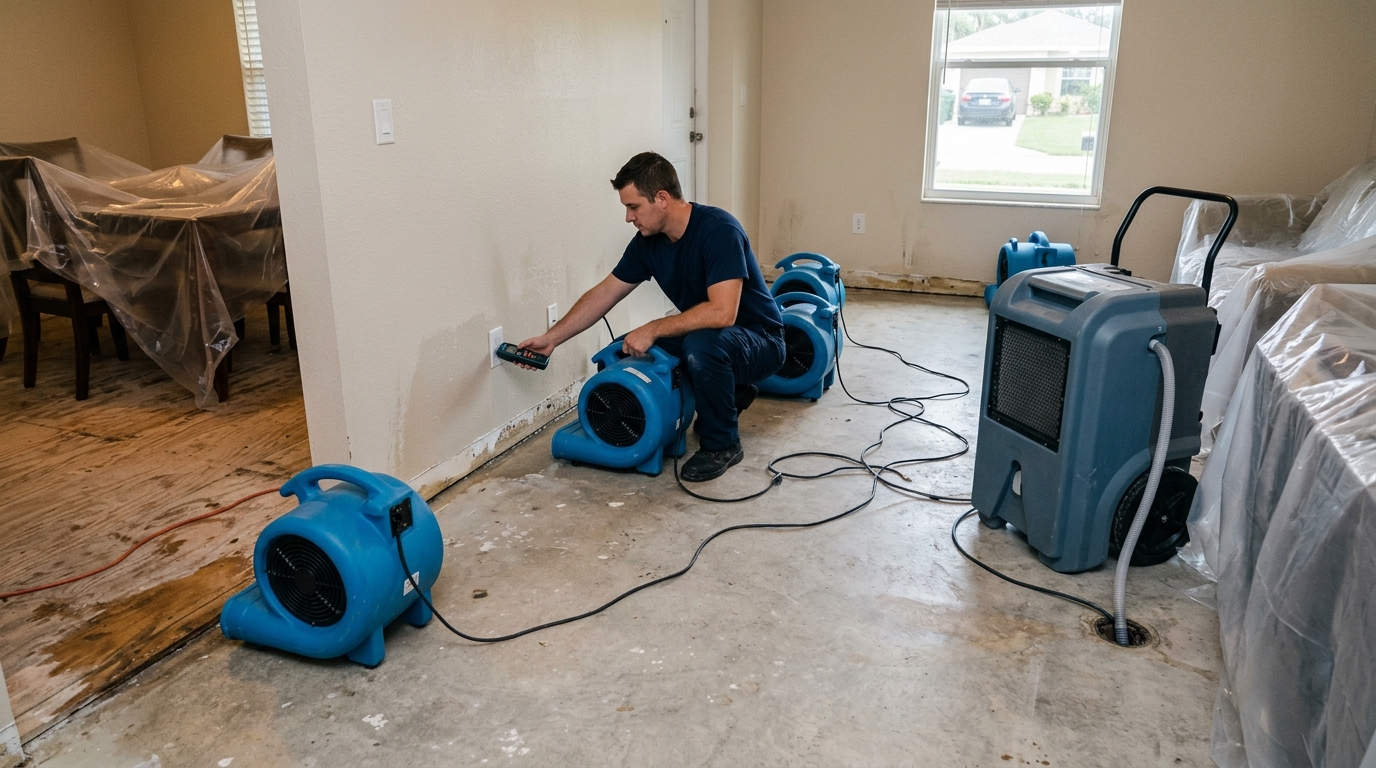
The Critical Distinction: Extraction vs. Structural Drying
A common misunderstanding among homeowners is assuming that once standing water is vacuumed from their floor, the property is “dry.” In the restoration industry, recovery is divided into two distinct operational phases:
1. Physical Water Extraction: The rapid removal of bulk liquid water from surfaces using commercial extraction wands, weighted extraction tools, and submersible pumps. This phase is fast—usually taking several hours—and removes liquid water hundreds of times more efficiently than evaporation. Read our guide on how long water extraction takes for details on the bulk removal operation.
2. Post-Extraction Structural Drying: The controlled scientific process of evaporating bound moisture that has deeply saturated porous building materials (concrete slabs, drywall gypsum cores, wooden sill plates, and subflooring), and extracting that moisture vapor from the air using commercial dehumidifiers. Structural drying is measured in days, not hours.
Why Building Materials Take 3 to 5 Days to Dry
Building materials are porous matrices that absorb water through capillary action. When moisture enters drywall, wood, or concrete, it exists in two distinct forms:
- Free Water: Liquid water occupying the large pores and surface voids of the material. Free water evaporates relatively quickly when exposed to moving air.
- Bound Water: Water held within the cellular or crystalline structure of the material by molecular hydrogen bonding. Bound water moves toward the surface very slowly through diffusion.
Accelerating the evaporation of bound water requires maintaining a continuous vapor pressure gradient: commercial low-grain refrigerant (LGR) dehumidifiers pull relative humidity down low, creating “thirsty” air that constantly draws deeply trapped moisture out of the materials. Even with high-capacity equipment, this physical diffusion process takes several days to complete safely without causing material cracking or warping.
Material-by-Material Drying Timelines
| Building Material | Typical Drying Window | Key Drying Considerations |
|---|---|---|
| Drywall (Gypsum Board) | 2 to 4 Days | Can dry in place if clean water and gypsum core remains firm without sagging |
| Wood Framing & Sill Plates | 3 to 5 Days | Must reach under 15% moisture content to prevent dry rot and mold growth |
| Poured Concrete Slab | 3 to 7 Days | High thermal mass holds deep moisture; requires high LGR dehumidifier capacity |
| Carpet & Re-usable Pad | 1 to 3 Days | Requires deep weighted extraction followed by directed high-cfm airflow |
| Cabinets & Millwork | 3 to 5 Days | Requires toe-kick ventilation and targeted air-injection systems |
The 5 Primary Factors Controlling Drying Speed in Florida
1. Ambient Outdoor Humidity and Temperature
Florida’s climate presents unique drying challenges. With outdoor relative humidity frequently hovering between 70% and 90%, opening windows does not dry a water-damaged home—it introduces massive quantities of atmospheric moisture. Professional drying requires closing all exterior doors and windows, creating a sealed drying envelope, and using commercial dehumidifiers to control the indoor psychrometric environment.
2. Depth and Duration of Saturation
A water pipe that burst 30 minutes before shutoff produces surface saturation that dries relatively quickly. Conversely, a leak that ran undetected for two days while homeowners were away allows water to soak completely through concrete slabs, baseboards, and structural studs, significantly extending the required drying duration.
3. Water Contamination Level
Clean water (Category 1) allows aggressive in-place drying. Contaminated water (Category 2 gray water or Category 3 black water) requires immediate demolition and disposal of porous materials like carpet padding and drywall before structural drying can safely begin. Review our guide on clean, gray, and black water categories.
4. Equipment Sizing and Placement (CFM and PPD)
Drying speed is directly correlated to equipment engineering. Standard restoration setups require:
- High-Velocity Axial Air Movers: Producing 2,500 to 3,500 CFM of focused laminar airflow across every 10 to 14 linear feet of wet wall.
- LGR Dehumidifiers: Rated to remove 100 to 150+ pints per day (PPD) under AHAM conditions (80°F / 60% RH), maintaining vapor depression below 40 grains per pound (GPP).
5. Flooring and Vapor Barriers
Modern luxury vinyl plank (LVP), sheet vinyl, and non-porous tile create vapor barriers over concrete slabs. When water migrates beneath these floors, it cannot evaporate upward through the material. Slabs beneath vapor barriers require specialized floor-drying mat systems or temporary plank removal to release trapped moisture.
Why “Surface Dry” Is Dangerous
Homeowners often touch a wall or walk on tile 24 hours after extraction and conclude that the room is dry because the surface feels dry to the touch. This assumption is a leading cause of long-term property rot and mold growth:
- Drywall surface paper dries rapidly while the gypsum core and wooden 2×4 studs inside the dark wall cavity remain heavily saturated.
- Ceramic tile feels completely dry while the concrete slab and mortar bed beneath register 90%+ moisture saturation on electronic meters.
- Carpet fibers feel dry while the dense foam padding underneath remains soaked with trapped water.
How Certified Restorers Verify True Dryness
Professional restoration companies do not guess or rely on touch. We verify dryness using calibrated scientific instruments:
- Pinless Moisture Meters: Use non-destructive radio frequencies to scan concrete slabs and tile up to one inch deep without puncturing surfaces.
- Pin-Type Moisture Probes: Deliver electrical resistance readings to measure the exact moisture content percentage (MC%) of wood studs, baseboards, and drywall.
- Infrared Thermal Cameras: Detect evaporative cooling patterns, producing clear visual heatmaps that outline moisture migration paths behind finished surfaces.
- Digital Thermo-Hygrometers: Track ambient temperature, relative humidity, and grains per pound (GPP) of moisture in the air daily to verify that dehumidifiers are actively extracting water vapor.
Drying equipment is only removed once all affected structural assemblies reach the pre-loss baseline moisture content established in unaffected areas of the home. Learn more in our article on how professionals know a structure is dry.
Frequently Asked Questions About Drying Timelines
Can I turn off the drying equipment at night to reduce noise?
No. Drying equipment must run continuously 24 hours a day until dry standards are achieved. Turning off air movers or dehumidifiers allows relative humidity to rebound rapidly, halting moisture evaporation and prolonging the overall drying timeline. It can also allow microbial growth to begin in warm, stagnant air.
What happens if building materials are not completely dried?
If materials are sealed up or flooring is reinstalled before the concrete slab or wall studs reach equilibrium moisture content, trapped moisture will degrade flooring adhesives, warp wood, corrode metal fasteners, and foster hidden mold growth inside wall cavities.
Does my air conditioning help dry the house?
Residential air conditioners do remove some moisture vapor as a secondary byproduct of cooling, but they are not designed for structural drying. In fact, running an AC at very cold temperatures lowers the ambient air temperature, reducing the rate of evaporation from wet materials. Professional LGR dehumidifiers are engineered specifically to extract deep moisture while maintaining ideal drying temperatures.
Need Water Extracted and Dried in Spring Hill?
Our specialized extraction and drying equipment removes moisture from your concrete slab, walls, and flooring to protect your home from permanent damage.