
The Essential Division of Professional Trades
When a pipe bursts or an appliance overflows, homeowners often feel overwhelmed and assume that calling a single professional will resolve the entire crisis. However, plumbing and water damage restoration are two distinct licensed trades with entirely separate tools, training, and operational lanes:
| Operational Responsibility | Licensed Plumber | Water Damage Extraction Company |
|---|---|---|
| Primary Focus | The mechanical water supply & drainage system | The building structure, flooring, and air quality |
| Core Action | Stops active leaks, repairs pipes, replaces valves | Extracts liquid, removes trapped moisture, dries materials |
| Specialized Equipment | Pipe wrenches, soldering torches, sewer cameras, crimpers | Truck-mounted extractors, LGR dehumidifiers, thermal cameras |
| Removes Standing Water? | No | Yes (High-volume extraction) |
| Dries Drywall & Slabs? | No | Yes (Scientific structural drying) |
| Insurance Documentation | Plumbing repair invoice for mechanical parts | Itemized mitigation logs, psychrometric records, photos |
Scenario Breakdown: Who to Call in Common Emergencies
1. Burst Pipe Inside a Wall or Ceiling
First Action: Shut off your home’s main water valve immediately. Refer to our guide on how to shut off your water during a leak.
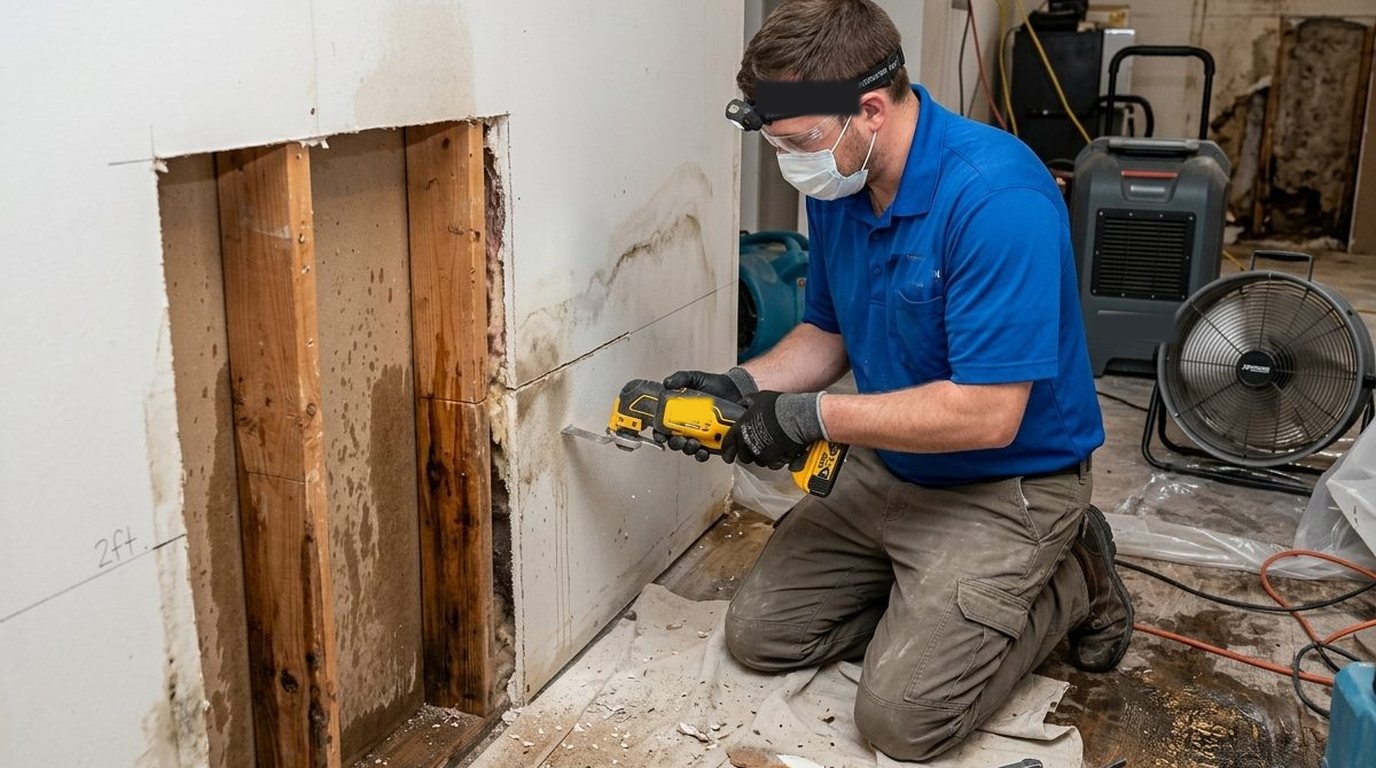
Who to Call: Call both concurrently. You need a licensed plumber to open the wall and repair or replace the cracked copper or PEX pipe. Simultaneously, you need a water restoration company to extract water pooling on floors, cut wet drywall away from structural studs (flood cut), remove saturated insulation, and set up dehumidifiers to prevent structural rot. Learn more about burst pipe water damage.
2. Slab Leak Beneath the Concrete Floor
First Action: Shut off the main water valve if water is actively pooling or warm spots are spreading across the floor.
Who to Call: Call both. A plumber is required to locate the underground line leak and either break through the slab or reroute a new PEX supply line overhead. The water extraction company is required to extract moisture that has risen into tile grout, carpet padding, and baseboards, and deploy commercial dehumidifiers to draw bound moisture out of the porous concrete slab. Read our dedicated guide on slab leak water damage.
3. Water Heater Rupture or Tank Leak
First Action: Turn off the cold water inlet valve on top of the water heater and turn off the circuit breaker powering the unit.
Who to Call: If the tank is actively flooding, call the water extraction company first to remove the 40 to 50 gallons of water spreading across the floor before it ruins adjacent flooring and drywall. Once the emergency water removal is underway, contact a plumber to install a replacement water heater. Explore our water heater leak cleanup guidance.
4. Washing Machine Hose or Dishwasher Leak
First Action: Close the dual supply valves behind the washing machine or the shutoff valve under the kitchen sink.
Who to Call: Call the water damage company first. Because the water source is already shut off, the primary crisis is the water standing on your floors and wicking into baseboards and cabinetry. An appliance technician or plumber can replace the failed hose later, but removing standing water within hours is essential to save your flooring. See our appliance leak cleanup page.
5. Toilet Overflow (Clean vs. Contaminated)
First Action: Shut off the chrome oval valve behind the toilet. Do not attempt repeated flushes.
Who to Call: If the toilet overflowed with clean tank water due to a stuck float, shut the valve and call a water extraction company to dry the bathroom. However, if the toilet overflowed with sewage or the drain line is clogged, you need a plumber to auger or clear the sewer line, and a certified water damage company to perform specialized biohazard extraction, sanitization, and containment.
Why Calling Only a Plumber Can Leave Your Home at Risk
A frequent mistake homeowners make is assuming that once the plumber leaves and the pipe is repaired, the job is finished. Consider what happens to the water left behind:
- Trapped Moisture in Concrete Slabs: Water on a Florida concrete slab doesn’t simply dry with open windows. Concrete absorbs water like a dense sponge, holding moisture for weeks and releasing it slowly under flooring adhesives, causing tiles to tent and laminate planks to buckle.
- Concealed Wall Cavity Moisture: Drywall wicks water upward 12 to 24 inches within hours. Even if the room air feels warm, the inside of the wall cavity remains dark and wet—creating the perfect environment for mold growth within 24 to 48 hours.
- Secondary Damage to Adjoining Rooms: Capillary action forces water beneath interior partition walls into neighboring closets, bedrooms, and under cabinetry that appeared untouched on the surface.
Plumbers do not carry commercial LGR dehumidifiers, high-velocity axial air movers, or infrared moisture mapping cameras. To fully protect your home, structural extraction and scientific drying must follow plumbing repairs immediately.
Frequently Asked Questions
Can a water damage company help me turn off my water?
Yes. If you cannot locate or turn your main water valve, our emergency dispatchers can guide you over the phone, and our technicians carry commercial curb keys to shut off the water at the street meter upon arrival.
Will my insurance pay for both the plumber and the water company?
In standard Florida homeowners insurance policies (HO-3), the insurance carrier typically covers the resulting water damage mitigation and structural repairs performed by the water restoration company. However, the cost of the plumber’s mechanical parts and pipe repair is often excluded or capped under standard policy terms. Review our guide on Florida homeowners insurance water damage.
Dealing With an Active Plumbing Leak in Spring Hill?
Our specialized extraction units remove standing water quickly from your floors and walls to prevent permanent structural damage and mold.