
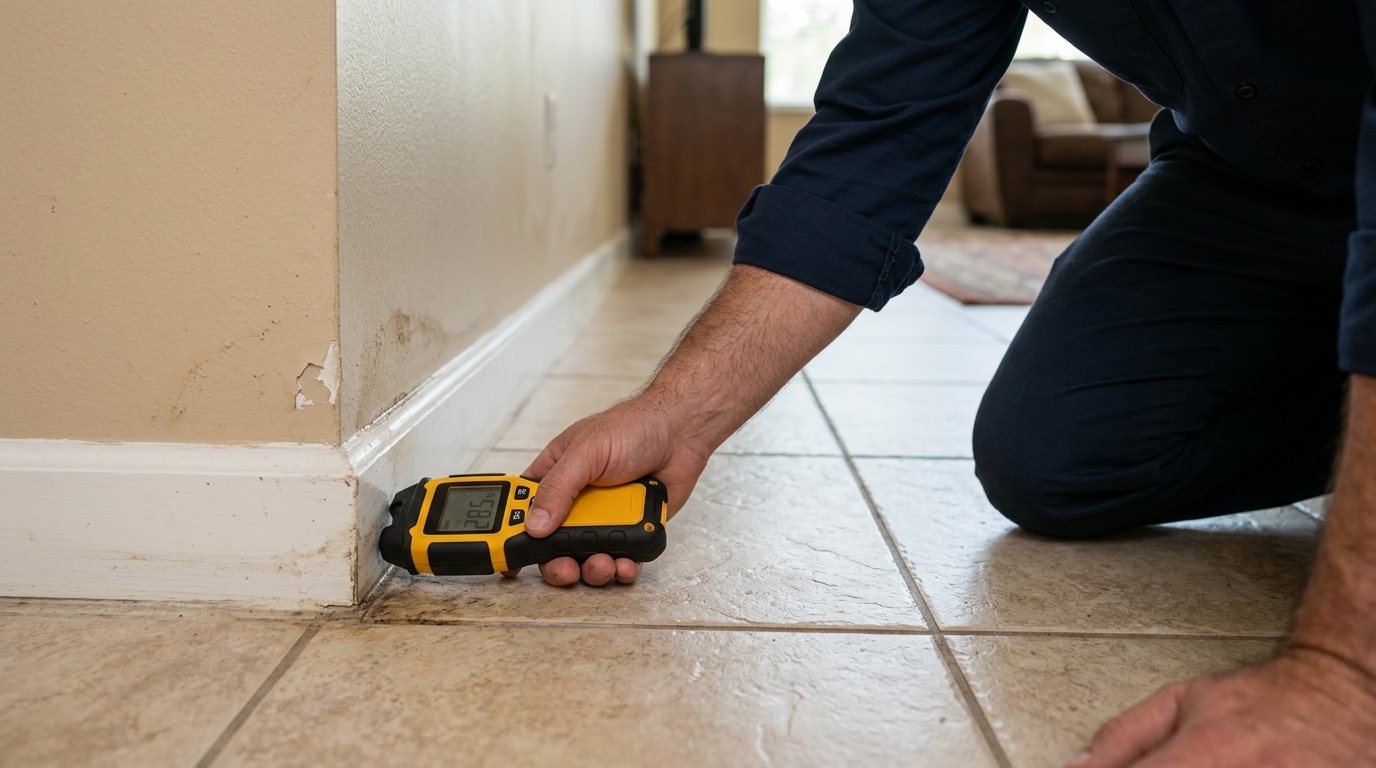
What to Do First When You Suspect a Slab Leak
If you discover warm spots on your floor, wet tile grout, squishy carpet, or bubbling baseboards with no overhead plumbing source, you may have a slab leak. Turn off the main water shutoff valve to stop active water flow. Avoid stepping in pooled water near electrical outlets. Contact a licensed plumber to locate and repair the broken pipe under the concrete, and engage a professional water extraction company immediately to remove standing water, map hidden subfloor moisture, and initiate structural drying.
What Is a Slab Leak and How Does It Damage Property?
Most residential homes in Spring Hill, Brooksville, and Hernando County are built on monolithic poured concrete slab-on-grade foundations. During construction, copper or PEX domestic water supply lines are routed beneath the ground and through the crushed rock sub-base before rising through the concrete slab into fixtures like sinks, showers, toilets, and water heaters.
A slab leak occurs when a pressurized water supply line beneath or encased within the concrete develops a break, split, or pinhole leak. Because the line operates under continuous municipal or well pressure (typically 45 to 70 PSI), water escapes relentlessly. Once the soil beneath the slab becomes fully saturated, the water seeks the path of least resistance—migrating upward through expansion joints, cold joints, cracks in the concrete, and plumbing penetrations into the living space above.
Critical Trade Distinction: Plumber vs. Water Extraction Company
When dealing with a slab leak, homeowners often face confusion about who to call. It is vital to understand the distinct operational roles of each professional trade:
- The Licensed Plumber: Responsible for locating and repairing the mechanical water line. Plumbers use electronic listening devices, line tracing, or pressure tests to pinpoint the leak. They perform the mechanical repair by jackhammering through the slab to fix the copper line, rerouting new PEX piping through the attic or walls, or trenching around the perimeter. Plumbers do not extract pooled water from flooring or dry saturated building materials.
- The Water Extraction & Restoration Company: Responsible for mitigating and drying the water that has already entered your home. Restoration specialists extract pooled water from tile, concrete, and carpet, remove saturated pad, map hidden moisture paths in drywall and cabinetry, install commercial LGR dehumidifiers and high-velocity air movers, and verify that the concrete slab and framing dry to safe equilibrium moisture levels.
In most slab leak emergencies, homeowners need both professionals working concurrently: the plumber stops the leak and repairs the pipe, while the water restoration crew removes the standing water and prevents structural rot and microbial growth. Read our detailed guide on calling a plumber or water damage company first.
Signs of Water Intrusion From a Slab Leak
Because the leak originates beneath the floor, water damage may develop subtly before large volumes of surface water become obvious:
- Warm Spots on the Floor: If a hot water supply line ruptures, heat transfers through the concrete slab. Walking barefoot across tile or laminate reveals localized warm patches.
- Damp, Discolored Carpet or Squishy Padding: Water rises through the slab and saturates carpet padding. The carpet may feel cool and damp, or squish underfoot when stepped on.
- Darkened or Wet Tile Grout Lines: Porous cementitious grout absorbs subterranean water, appearing dark or wet along floor seams even after mopping.
- Swollen Baseboards & Peeling Wall Paint: Water wicks into the bottom edges of baseboards and the lower margin of drywall, causing baseboards to bow outward and paint to bubble or flake.
- Damp or Musty Odors: Stagnant water trapped beneath flooring and inside dark wall cavities generates characteristic musty odors within 24 to 48 hours.
- Continuous Water Meter Activity: If all faucets and appliances are shut off and your water meter dial continues spinning, pressurized water is escaping somewhere in your plumbing system.
How Moisture Migrates Across Concrete Slabs
Concrete is porous. Under normal conditions, a slab acts as a dense, stable foundation. However, when pressurized water is forced against the underside of the slab, moisture travels through microscopic capillary channels—a process known as capillary action or moisture wicking.
Once water reaches the slab surface, it moves horizontally under floor coverings. In central Spring Hill homes, particularly in the 34608 area, large open-concept floor plans allow water to travel tens of feet away from the original pipe break. Water frequently emerges in an adjoining hallway, bedroom, or closet far from the actual leak site. This is why visual inspection alone is completely inadequate for determining the true boundary of slab water damage.
The Slab Leak Water Extraction & Drying Process
Proper mitigation of slab leak water damage follows four coordinated phases:
1. Immediate Bulk Water Removal: Commercial extraction units remove standing water from tile, concrete, and carpet surfaces. Removing bulk liquid quickly stops water from continuing to wick into surrounding wall assemblies.
2. Selective Material Assessment: Porous floor coverings must be evaluated based on water contamination and saturation depth. Saturated carpet padding usually requires removal, while salvageable carpet can be lifted and dried. Interlocking laminate or luxury vinyl plank (LVP) trapping water against the slab may need to be dismantled to expose the wet concrete.
3. Non-Invasive Moisture Mapping: Restoration technicians use non-penetrating moisture meters and thermal imaging cameras to map the exact perimeter of moisture migration across the slab and up interior drywall partitions.
4. Deep Structural Dehumidification: Concrete slabs hold large volumes of bound moisture. Drying a slab requires high-performance low-grain refrigerant (LGR) dehumidifiers operating in tandem with centrifugal air movers. The air movers accelerate surface evaporation, while the dehumidifiers extract vapor from the air, pulling the slab’s internal relative humidity down to safe industry standards.
Where Moisture Can Hide During a Slab Leak
Because slab leaks emerge from below, moisture easily conceals itself in vulnerable architectural assemblies:
- Bottom Wall Plates (Sill Plates): The 2×4 wood plates bolted to the concrete slab absorb water directly from the slab surface, remaining damp long after surface water is dried.
- Drywall Core: Gypsum drywall acts as a continuous wick, pulling water upward 12 to 24 inches within wall cavities.
- Under Kitchen & Vanity Cabinets: Water flows beneath cabinet kicks, saturating the unfinished particle board sub-bases that cannot be seen from above.
- Under Door Thresholds & Tile Underlayment: Uncoupling membranes or thin-set mortar beds can trap water against the concrete, delaying natural drying.
Related Services for Slab Leak Water Damage
Property owners confronting slab leak water damage benefit from integrated restoration services:
- Emergency Water Extraction: Rapid removal of standing water from flooring and subfloors.
- Moisture Detection & Thermal Imaging: Precision mapping of below-floor and in-wall moisture spread.
- Structural Drying: Industrial dehumidification to draw moisture out of concrete slabs and framing.
- Plumber vs. Water Company Guide: Clear guidance on coordinating plumbing repairs with water mitigation.
Frequently Asked Questions About Slab Leaks
Can a concrete slab dry on its own after a leak is fixed?
No. A concrete slab encased by indoor flooring and walls cannot dry effectively on its own in Florida’s humid climate. Moisture trapped inside concrete will slowly migrate into baseboards, drywall, and flooring adhesives over months, causing long-term rot, adhesive failure, and microbial growth. Commercial dehumidification is required to draw the moisture out.
Do I have to move out while my slab leak is dried?
In most residential slab leak losses, occupants can remain in the home, provided essential living areas, power, and sanitation remain functional. Drying equipment does produce warmth and fan noise, and certain rooms may be cordoned off with containment barriers during active drying.
Does Florida homeowners insurance cover slab leak damage?
Most standard homeowners policies cover the resulting water damage caused by a slab leak—including water extraction, structural drying, and repairing damaged flooring, baseboards, and drywall. However, many policies exclude or cap the cost of accessing and repairing the plumbing pipe itself. Review our guide on Florida homeowners insurance water damage for detailed claim documentation advice.
Dealing With Slab Leak Water in Spring Hill?
Our specialized extraction equipment removes water from your floors and dries your concrete slab to prevent structural decay and mold.