
Why Standardized Price Tables Are Misleading
When homeowners search online for water extraction costs, they frequently encounter generic national price tables quoting broad, arbitrary ranges such as “$1,500 to $5,000.” In reality, these figures are rarely helpful for a homeowner standing in an ankle-deep flooded hallway in Spring Hill, Florida.
Water extraction is not a uniform, commodity service. A clean water leak from a broken copper pipe that is extracted within two hours from a 150-square-foot tiled laundry room requires a vastly different scope of labor, equipment, and disposal than a contaminated sewage backup that has saturated 800 square feet of carpet, padding, and drywall across multiple bedrooms over a weekend. Transparent restoration pricing reflects the exact physical scope of the loss, the specialized equipment deployed, and the labor hours necessary to achieve verified structural dryness.
The Core Variables That Determine Water Extraction Costs
Professional water damage restoration in Hernando County is calculated using standardized industry estimating software (such as Xactimate, the benchmark used by insurance carriers nationwide). Pricing is built from specific unit costs based on the following physical factors:
1. Standing Water Volume and Depth
The first task is removing liquid water from the structure. A shallow spill covering a floor requires surface extraction with commercial floor wands. Conversely, deep standing water resulting from a ruptured main supply line, major water heater failure, or storm surge requires submersible trash pumps, high-capacity vacuum extractors, and containment staging to pull thousands of gallons out of the building. The time and equipment capacity needed for physical extraction scale with the total volume of liquid.
2. Total Square Footage and Room Configuration
Larger surface areas require more labor, more extraction passes, and a greater number of commercial drying units to create proper airflow vortices. Furthermore, room layout matters: an open-concept living area of 600 square feet is often simpler to extract and dry than four separate small bedrooms and closets of equivalent total square footage, which require multiple containment barriers, separate ducting, and individualized equipment placements.
3. Types of Affected Building Materials
Different materials respond to water in drastically different ways, dictating the restoration approach and associated costs:
- Ceramic & Porcelain Tile: When installed over a concrete slab, tile is non-porous and can frequently be saved if water is extracted before it penetrates deeply into perimeter drywall.
- Carpet and Underlayment: Extracting water from carpet requires heavy-duty weighted extraction tools. If clean water is involved, carpet padding can sometimes be dried in place, but often the padding must be detached, removed, and discarded, while the carpet is cleaned and dried.
- Laminate and Luxury Vinyl Plank (LVP): Interlocking vinyl plank and laminate create vapor-tight layers over concrete slabs. Water trapped underneath cannot evaporate through the planks. If water cannot be removed with specialized floor-drying mat systems, the flooring must be carefully uninstalled to allow the concrete slab underneath to dry.
- Drywall, Baseboards, and Wood Framing: Drywall absorbs water rapidly through capillary action. If moisture has wicked more than a few inches upward, baseboards must be removed, and ventilation holes or selective bottom cuts (flood cuts) may be necessary to dry the interior wall cavities.
- Custom Cabinetry: Kitchen islands and bathroom vanities constructed from particle board swell permanently if water stands around their bases. Rescuing cabinetry requires specialized toe-kick removal and focused air-injection systems.
4. Water Contamination Category (Clean, Gray, or Black Water)
Industry standards (IICRC S500) categorize water into three contamination levels, each requiring distinct safety protocols, disposal requirements, and labor rates:
- Category 1 (Clean Water): Originates from sanitary sources such as broken domestic water supply lines, overflowing sinks, or rainwater. It requires standard extraction, drying, and minimal personal protective equipment (PPE).
- Category 2 (Gray Water): Contains significant chemical, biological, or physical contamination. Sources include washing machine overflows, dishwasher discharge, or aquarium leaks. Gray water requires sanitization, targeted removal of porous items like carpet pad, and protective gear for technicians.
- Category 3 (Black Water): Grossly unsanitary water containing pathogenic agents. Sources include sewage backups, toilet overflows containing feces, and outdoor rising floodwaters. Black water requires full biohazard containment, negative air pressure scrubbers, disposal of porous materials, and thorough antimicrobial decontamination. Labor and disposal costs for Category 3 losses are considerably higher due to necessary health and safety protocols. Read our detailed guide on clean, gray, and black water categories.
5. Structural Drying Equipment & Duration
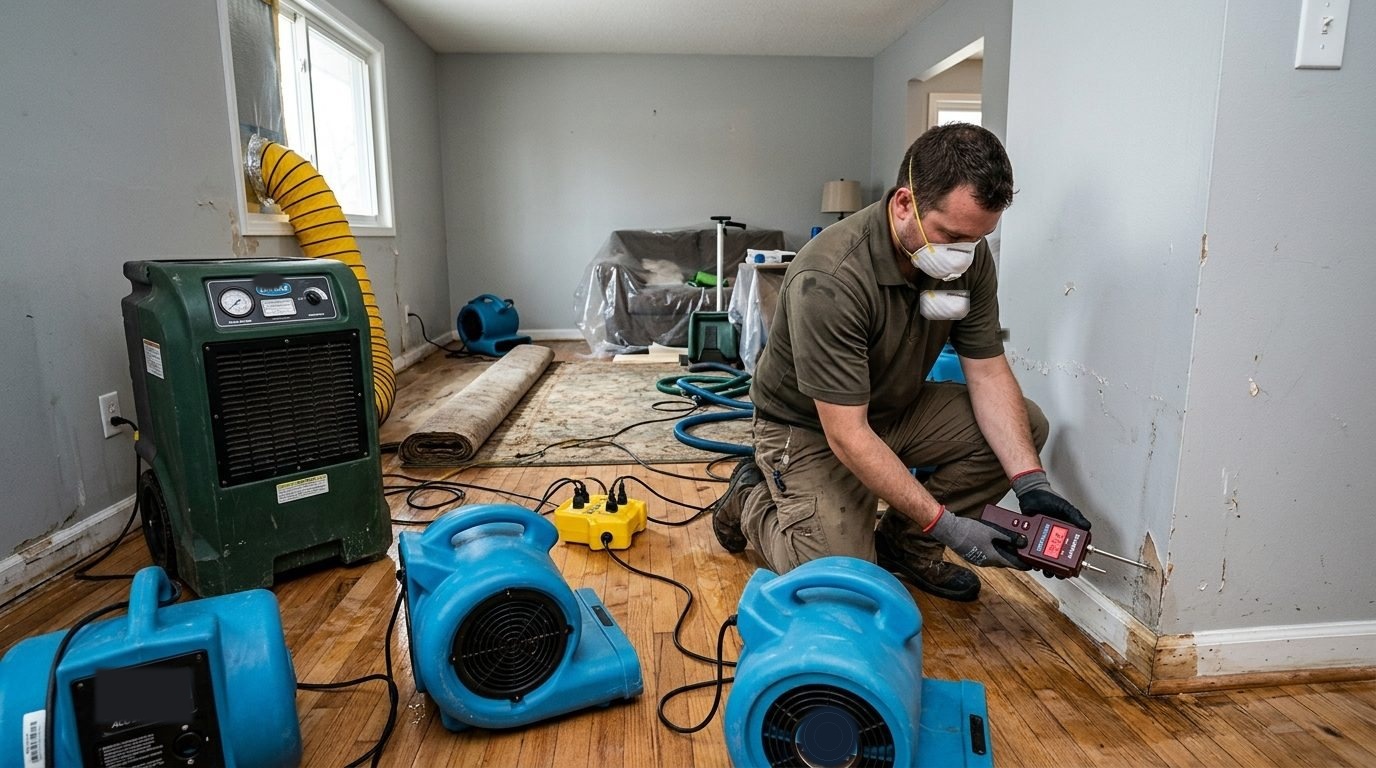
Physical extraction removes liquid water, but the bound moisture inside concrete slabs, drywall, and structural studs must be evaporated through scientific dehumidification. Drying equipment costs are calculated per unit per day:
- Low-Grain Refrigerant (LGR) Dehumidifiers: Commercial units capable of removing 80 to 150+ pints of water vapor per day from the air under challenging conditions.
- High-Velocity Axial & Centrifugal Air Movers: Industrial fans that direct focused air across wet surfaces to accelerate evaporation.
- HEPA Air Filtration Units (Air Scrubbers): Deployed to capture airborne particulate, microbial spores, and odors during demolition or contaminated water cleanup.
Most residential structures in Spring Hill require 3 to 5 days of continuous equipment operation to reach verified dry baseline standards. Learn more in our article on how long water damage takes to dry in Florida.
6. Response Time & Secondary Damage Prevention
The time elapsed between the water release and the start of extraction is one of the greatest cost multipliers. Water extracted within the first 1 to 4 hours is largely a surface extraction project. When water sits for 24 to 48 hours in Florida’s warm, humid climate, moisture wicks high into wall cavities, flooring adhesives dissolve, baseboards rot, and microbial growth begins, transforming a straightforward extraction into a complex remediation project.
Homeowners Insurance and Water Extraction Costs
In the vast majority of sudden and accidental water losses—such as a burst supply line, water heater tank rupture, or appliance overflow—the cost of emergency water extraction, moisture mapping, and structural drying is covered under standard Florida homeowners insurance policies (HO-3). Key insurance considerations include:
- The Duty to Mitigate: Insurance policies obligate the homeowner to take reasonable steps to prevent further damage after a loss. Calling a certified water extraction company immediately demonstrates active mitigation.
- Deductible Application: The homeowner is typically responsible for their policy’s standard property deductible (often $1,000 or $2,500), while the insurance carrier covers approved mitigation and structural restoration costs above that threshold.
- Detailed Documentation: Professional restoration companies provide itemized line-item invoices, psychrometric drying logs, moisture meter readings, and date-stamped photographs that insurance adjusters require to approve claims smoothly. Explore our comprehensive guide on Florida homeowners insurance water damage.
How to Request an Accurate On-Site Assessment
When contacting our water extraction team, being prepared with basic details helps our dispatchers assign the appropriate equipment immediately:
- Identify the source of the water (plumbing line, water heater, appliance, toilet, storm).
- Note which rooms and flooring types are covered in water (tile, carpet, laminate, vinyl).
- Estimate whether water is actively flowing or has been stopped at the shutoff valve.
- Mention whether water appears clean or discolored/contaminated.
Our technicians arrive with truck-mounted extraction equipment, commercial pumps, and non-invasive moisture meters to assess the exact spread and provide a transparent, professional mitigation plan.
Frequently Asked Questions About Water Extraction Costs
Is water extraction cheaper if I rent fans from a home improvement store?
Consumer-grade box fans and standard rental dehumidifiers lack the volumetric airflow and low-grain moisture extraction capacity required to pull bound moisture out of concrete slabs and drywall. In Florida’s high humidity, running household fans often circulates humid air without drying the structural framing, allowing hidden moisture to rot sill plates and cultivate mold behind baseboards. Professional restoration prevents catastrophic long-term reconstruction costs.
Does water extraction include repairing the plumbing leak?
No. Water extraction and structural drying are specialized restoration operations focused on removing water and protecting building materials. Plumbing repairs—such as soldering copper pipes, replacing valves, or fixing drain lines—must be performed by a licensed plumber. See our guide on who to call first between a plumber and water damage company.
What if I only need standing water pumped out of one room?
Targeted extraction for a single room with minimal water spread is a focused service. Our technicians extract the standing water, verify moisture levels in adjoining walls with digital meters, and advise you honestly on whether active dehumidification is necessary or if localized drying is sufficient.
Need Water Removed From Your Spring Hill Property?
Our specialized extraction equipment removes standing water rapidly to protect your concrete slab, walls, and flooring from secondary damage.